
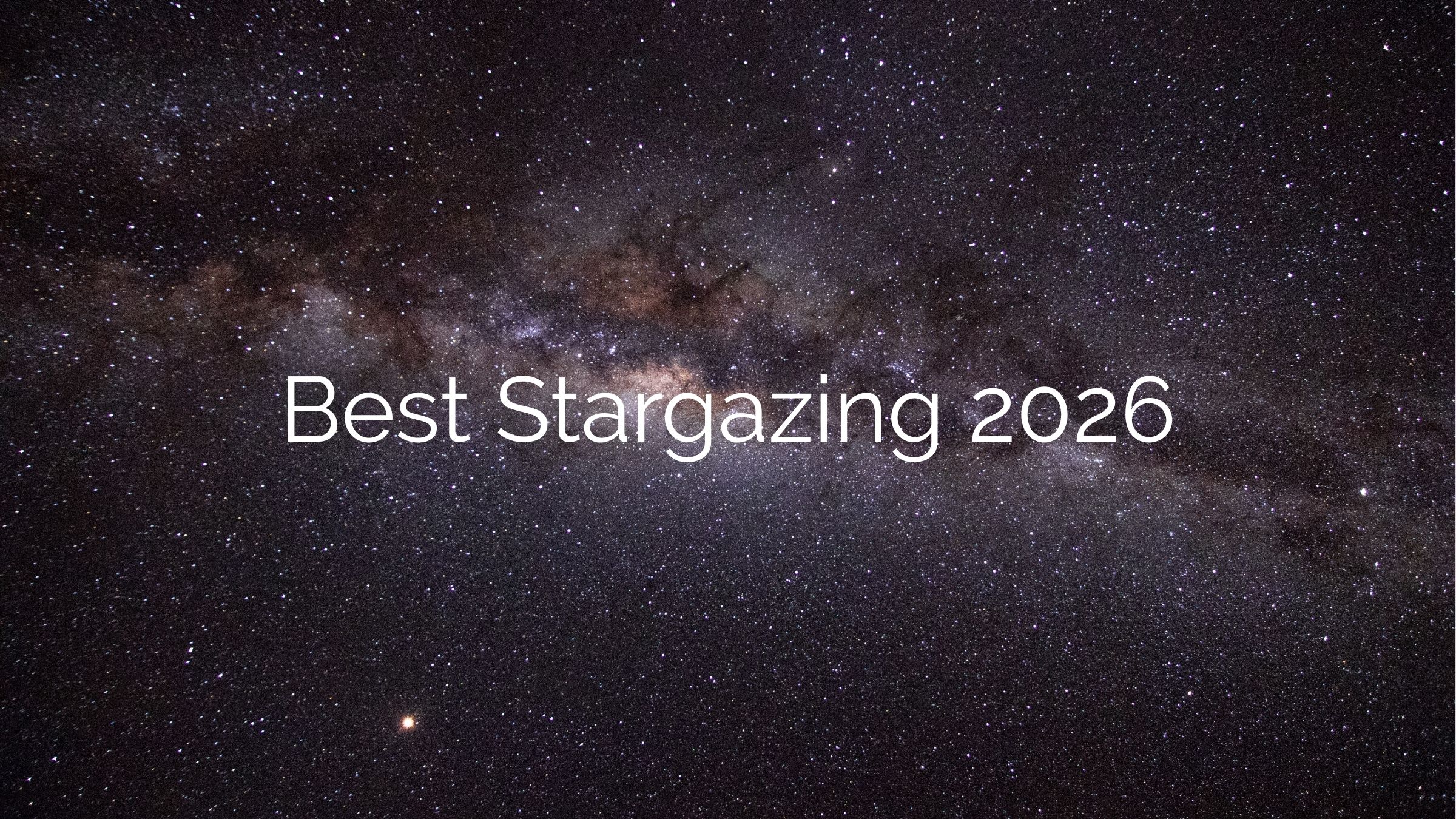
The spectacular Western Australian night sky will be on show in 2026. We’ve put together your handy list, so you won’t miss a moment of the spectacular stars and the awe-inspiring Milky Way.
Low light pollution in WA means that stargazing is a world-class experience and you can experience the breath-taking night time views in all their glory.
We’ve created a seasonal calendar of the ultimate night sky events and places to discover WA’s best stars.
Escape bright city lights and visit one of WA’s fantastic Astrotourism Towns for a better stargazing experience: you’ll be amazed by how many more stars you can see in the night sky.
Let’s turn out the lights and look to the skies for the best stargazing in 2026!
January: Go Galaxy Hunting
Imagine seeing another galaxy with your own eyes! In the southern hemisphere, you can! The Magellanic Clouds are our Milky Way Galaxy neighbours and can be seen with the naked eye without a telescope or binoculars. All you need is a dark sky location with no moonlight. When are the best dates and times to see the Magellanic Clouds?
February: Planet Bucket List
If you’ve dreamed of ticking multiple planets off your bucket list in the one night, here’s a great chance! The Sun will have only just set, but you should still be able to catch a glimpse of Venus and Mercury very low on the western horizon before they disappear from view. As the sky darkens, Saturn and Jupiter will be visible to the naked eye. To see Neptune and Uranus, you’ll need a pair of high magnification binoculars or a medium sized telescope. Put 19th February in your diary for this one.
March: Total Eclipse of the Moon
This impressive sight will be an early evening delight on 3rd March. Watch as the Earth’s shadow crosses the surface of the Moon and turns it a stunning coppery/red colour. At moon rise (6.43pm AWST), observers will see the partial eclipse underway. The Total Lunar Eclipse starts at 7.04pm (AWST) and ends at 8.02pm (AWST).
April: Planet Parade on Anzac Day Dawn
Dawn on Anzac Day this year is extra special. If you regularly attend dawn services, you’ll know that the view of the stars and planets change from year to year. This year, there are three naked-eye planets visible in a celestial line up – Saturn, Mars and Mercury. The view will add to the poignancy of this very special morning.
May: Dance of the Planets
From mid May and into the month of June, stargazers are in for stunning evening night sky views! It’s the best stargazing all year! The planets of Venus, Jupiter and Mercury will put on a show that will change every night. It’s the motion of our Solar System in action! How do I see it?
June: Finding the Emu in the Night Sky
The Southern Cross is Australia’s most iconic constellation. It’s on the flag and in our hearts! Did you know it can only be seen from the Southern Hemisphere? Track it over time as it graces the southern skies. It’s also the best time to see one of the best-known Aboriginal constellations, the Emu in the Sky.
July: It’s Milky Way Season
Milky Way Season is in full swing! If you’ve never seen the Milky Way on a moonless night August is perfect time to experience it. Sometimes this thick band of stars look so close, you could almost reach out and touch them. The Milky Way is simply stunning and is sought after by astrophotographers near and far. When are the right dark nights to see the Milky Way at its best?
August: Jupiter & Mercury Pair Up
In the early morning of 15th August, stargazers are treated to a close approach of the planets Jupiter and Mercury in the pre-dawn sky. The proximity to sunrise will make it difficult and a straight view to the eastern horizon will be essential.
September: What is That Bright “Star”?
In Spring, if you’re asking yourself “What is that bright star I can see in the evening?”, wonder no more. It’s not a star at all, it’s our neighbouring planet, Venus and it will make a striking sight in the evening in the west on 23rd September and in the early morning in the east on 28th November. On these days, Venus is at what is known as “greatest brilliance” and is the brightest it gets for the year.
October: Mercury Meets Venus
On 12th October, Mercury and Venus are the “stars” of the show! The pair of naked-eye planets appear on either side of a thin crescent Moon after sunset. Mercury is the planet above the Moon and Venus is below. If you turn around to look at the eastern horizon, see if you can work out which star-like object is Saturn!
November: Supermoon Time
You’ve probably heard about ‘supermoons’, but what are they? In the strictest sense, supermoon isn’t an astronomy term. The Moon’s orbit around Earth is slightly oval shaped or elliptical and every month there’s a time when the Moon is at its closest distance to Earth (at perigee). If the Moon is full at this time, it’s called a supermoon.
December: Catch a Falling Meteor Shower!
This year’s Geminids Meteor Shower is the best for the year. It coincides with a new Moon, so the sky will be wonderfully dark. This means you’ll be able to spot more meteors, commonly known as shooting stars, than ever. The meteor shower peaks on the night of the 14th December and into the early hours of the morning of the 15th.
There you have it! Our top tips to WA’s world-class dark night sky. Now all you need to do is plan your astro getaway and put yourself amongst the stars! Try a stargazing itinerary or visit your favourite Astrotourism Town.
For more to see in the night sky, check out What’s up in the Night Sky and the Astrotourism Towns map.
FIND THE BEST PLACES TO STARGAZE WHEN YOU'RE ON HOLIDAY
New dark sky stargazing locations are popping up in country WA