

Exactly two years until the next total solar eclipse brings global visitors to Western Australia. WA’s second total solar eclipse in five years crosses our coastline on 22 July, 2028.
Visitors to the Kimberley will get to stand in the Moon’s shadow in Purnululu National Park and Lake Argyle, as well as towns including Kununurra and Wyndham.
The Great Australasian Eclipse gets its name in part from being one of the longest total solar eclipses this century, with its greatest totality lasting more than five minutes.
Eclipse observers can expect to see the Sun’s bright disc slowly covered by the Moon’s silhouette, producing an ever-diminishing solar crescent.
The Kimberley total solar eclipse begins in the Indian Ocean, crossing over Cocos Keeling and Christmas Islands before reaching the WA coast. For five minutes and 10 seconds, the Moon will completely block the Sun’s rays, casting an eerie shadow over the Kimberley.
While the exact Kimberley location for witnessing the full five minutes and 10 seconds is inaccessible, totality will last five minutes and three seconds where the Great Northern Highway intersects the eclipse centre line.

Carol Redford experiences the 2017 ‘Great American Eclipse’ with appropriate eclipse glasses. Image credit: Astrotourism WA.
Eclipse Economy
Astrotourism is a growing international trend and the July 2028 total solar eclipse is already creating fresh opportunities to market WA’s dark sky tourism worldwide.
Drawing global attention, a total solar eclipse attracts large crowds of people, known as ‘Eclipse Chasers’, to places along the eclipse’s path of totality.
In April 2023, thousands of visitors flocked to the Gascoyne and Pilbara region to see the total solar eclipse, with many enjoying all that Western Australia tourism has to offer, including its world-class dark night sky.
From a global perspective, WA has an asset that is disappearing worldwide and is worthy of protection. Tourism WA’s Visitor Experience and Expectations Research (VEER) 2023-24 reported that almost all visitors (95%) were interested in dark sky activities or experiences.

Between 2023 and 2038, WA will see more total solar eclipses than any other state. Image credit: Astrotourism WA.
Internationally recognised dark skies
Australia has nine dark sky places across the continent, and in June 2026, Queensland became the second Australian state after South Australia to host an internationally recognised Dark Sky Reserve. The two states are also home to Australia’s only two Dark Sky Sanctuaries.
Redford says the establishment of Astrotourism Towns across the Mid West, Wheatbelt, Goldfields and Gascoyne is setting WA up for investment in dark sky tourism.
“It’s building a legacy that goes beyond the 2023 and 2028 eclipses, to the three more that will follow: 2030 (not visible in WA), 2037 (Geraldton and Mid West), and 2038 (Pilbara),” Redford says.
“Between 2023 and 2038, WA will see more total solar eclipses than any other state, and more than anywhere else in the world.”
As light pollution robs more people of access to the night sky, increasing numbers are now travelling to see dark skies and astronomical events, such as eclipses.
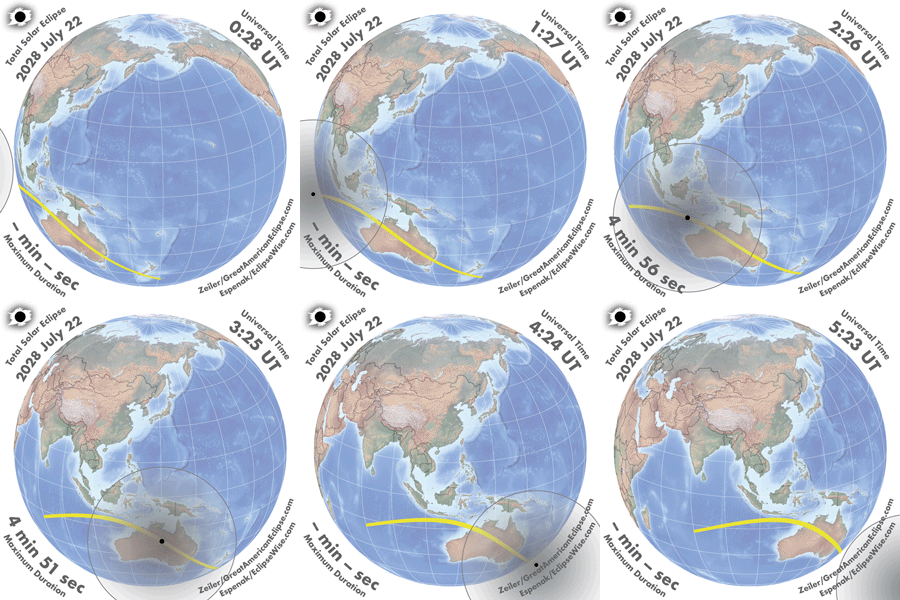
Global Map Animation of Eclipse courtesy of Michael Zeiler (GreatAmericanEclipse.com) and Fred Espenak (EclipseWise.com)
visit an Astrotourism Town
Western Australia’ Astrotourism Towns form a Dark Sky Stargazing Network courtesy of Trails WA.
Recent Comments